History
Aborginal History
The original inhabitants of the Colo river valley were the aborigines. The Darug language group lived peacefully in the Colo area until the advent of white settlers from England.
The name of the river “Colo” is the local aboriginal word for Koala.
The Colo River valley is subject to relatively frequent and violent floods and this has washed away much of the signs of early aboriginal occupation of the valley. The sandstone plateau area above the junction of the Putty and Lower Colo rivers is called known as “Moran’s Rocks”. This area was known to be sacred to the local aboriginal people.
I am not aware of any aboriginal cave art or relics in close proximity to the house. There are a number of cave painting sites in the Wollemi National Park further north.
European History
A second expedition up the Hawkesbury was commenced on 28th June, 1789 by Governor Phillip, who was accompanied by Captains Hunter, Collins and George Johnston and Surgeon White. During this expedition the Colo River was explored and named “Second Branch”, the first branch on the Hawkesbury River being the Macdonald River. It is believed that, on Friday 3rd July 1789, they rowed approximately 12kms up the Colo from the Hawkesbury and stopped at the sand bank just east of the present day bridge on the Putty road. Read about it here:
http://trove.nla.gov.au/newspaper/article/85813626
White settlers were living on the bank of the Colo from early 1800s with the first land grants being made in 1804 on the banks near the mouth of the river where it joins the Hawkesbury. Significant other land grants were made in 1833.
In the pre-motor vehicle era the Colo was serviced by boats which brought in goods for sale and took farm produce to the Hawkesbury River at Lower Portland from where the goods were put on bigger boats for Sydney. There was a wharf, “Gees Wharf” at the end of the tidal zone just east of the point where Wheeny Creek flows into the Colo, approximately 1 klm upstream from the Putty .
Soon after the Bells line of road was established across the Blue Mountains a track from Kurrajong to the Upper Colo was established. This road was then and still is now called Comleroy (Cumleroy) Road.
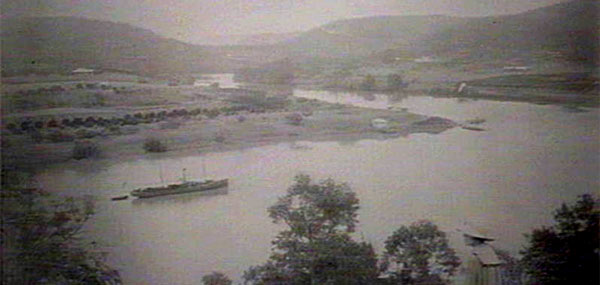
Property History
The property is one of the earliest settled properties in Australia. This area was originally settled by the McDougall Family. Three brothers: Andrew, James and John McDougall set out from their family home “Roxborough Park” in present day Baulkham Hills in Sydney to make their living on the Colo. The “Roxborough Park” name has not been lost and today there is Roxborough Park Road in Baulkham Hills which is the approximate location of the family farm.
The McDougall’s were on the Colo land from approx 1809 and the land was promised to them by Governor Macquarie on 16th January 1816, but at the time there was a moratorium on land grants and a formal land grant was not made until 1833. You can read the notification of the land grant here:
http://coloriver.com.au/history/Sydney%20Gazette%2030th%20Nov%201833.pdf
This property was part of a 100 acre land grant made to James McDougall. Our current 10 acres is the middle section. The original 100 acres included the properties on either side of ours.The property was called “Malvina Bower”. “Malvina Bower” is probably a reference from the poems of Ossian (see below).
James’ other brothers owned properties that still carry their original names. “Ossian Hall” was probably owned by John McDougall and is approximately 2klm upstream from where you are standing. Andrew McDougall owned “Teviotdale” which is on the other side of the river from Malvina Bower. There is a map in the folder.
The McDougall’s arrived in Australia in 1798 on the SS Barwell and were some of the earliest free settlers to Australia. The family had previously lived in Kelso, Roxburghshire, Scotland. The names “Ossian” and “Malvina Bower” possibly owe their origin to a series of epic Scottish poems. “Ossian” is the narrator of a series of poems published by the Scottish poet James Macpherson in 1760. The main characters of these poems are Ossian, the narrator, relating the stories when old and blind, his father Fingal (very loosely based on the Irish hero Fionn Mac Cumhaill), his dead son Oscar (also with an Irish counterpart), and Oscar’s lover Malvina who looks after Ossian in his old age.
Records reveal that McDougall family ran cattle with records of them being granted cattle from Government stores in 1814 and selling meat back to the Government on in 1817.
Ultimately, James McDougall moved to a property at Singleton where he died on October 5, 1856, aged 61. Andrew married Elizabeth Bowden on 14th January, 1831 and they had 10 children. While he lived at Singleton until his death, he retained his 100 acre Colo property of which you are reading about.